
Ready for immediate shipment, delivery time: 1-3 days, abroad + bulky goods longer delivery time
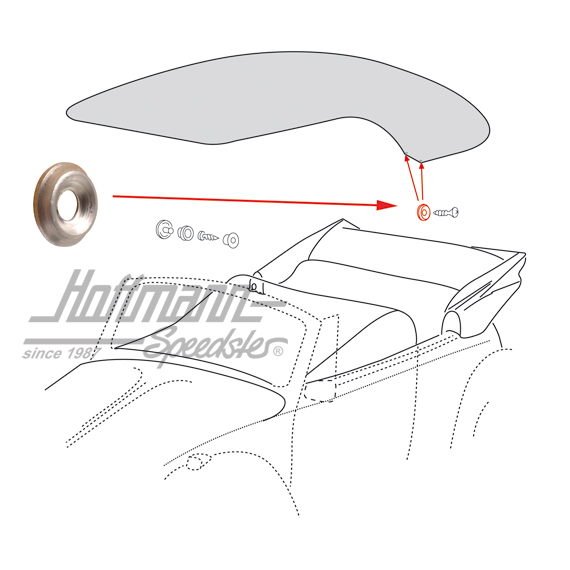
Attachments for the dust covers made from Sonnenland fabric for a Bus
Attachments for the VW Bus T2 Convertible Top – Small Components with an Important Function
Attachments perform important detailed tasks in the construction and fastening of a convertible top. In this category for the VW Bus T2, a specific conical washer is listed as a component for the corresponding top area. With small installation components like these, it is particularly important to select the intended version and use it in the correct position. Although an individual attachment may appear insignificant compared with the complete top or its mechanism, it can perform a specific task within a connection. Existing parts should therefore not simply be replaced with arbitrary fasteners when working on the convertible top. Instead, the required component should be clearly identified according to its designation and the existing installation situation.
Why Are Attachments Important for the VW Bus T2 Convertible Top?
The attachments are components that complement individual areas of the top construction and can connect them during installation. The category page specifically lists a 12.5 mm conical washer. Such a specific washer should be used where exactly this version is intended for the existing connection. Unlike large top components, the importance of these parts lies primarily in the details of their particular installation position. During repair, disassembly or restoration work, you should therefore pay attention to which small components were present during dismantling and how they were installed. This helps prevent a required attachment from being forgotten or replaced by an unsuitable version.
When Should I Inspect or Replace Convertible Top Attachments?
Checking the attachments is particularly advisable when work is being carried out on the convertible top, a connection is dismantled or an existing component is removed. Check whether the respective parts are complete and whether any visible damage or deformation can be detected. Small installation and connecting parts can easily be overlooked during dismantling. If an existing conical washer is removed, you should therefore check whether it remains suitable for the intended installation. Replacement is particularly appropriate if a required part is missing, visibly damaged or if the existing version does not correspond to the required component. Fixed replacement intervals cannot generally be specified for attachments of this type.
What Is Important When Installing and Replacing Attachments?
With attachments for the convertible top area, you should follow the existing construction and the specific installation situation. Small differences can determine which component is required.
- Document the installation position: When dismantling, note where a small attachment was installed and how it was positioned within the connection.
- Compare the version: Compare the removed part with the required replacement component, paying attention to the specific product designation and stated size.
- Check for damage: Inspect existing washers and connecting parts for visible deformation or other damage before using them again.
- Consider the installation situation: Use the component only in its intended position and follow the existing top construction during installation.
Especially during a restoration, it is helpful to record the position of small components while dismantling them. This makes it easier to determine which attachment was installed in which position when the convertible top is later reassembled.
Which Attachments Fit My VW Bus T2 Convertible Top?
When selecting suitable attachments, you should first determine which specific component is required on the top construction. The conical washer listed here is specified as 12.5 mm. Before replacement, you should therefore check whether exactly this version is required for your existing installation situation. If possible, compare the removed component and its position with the product designation. The category itself does not provide sufficient information for broader general statements about compatibility with specific production years or top versions. For this reason, precise identification based on the required individual component is important. This prevents you from selecting a visually similar fastener solely because of its shape when a specific version is intended for the existing connection.