
Ready for immediate shipment, delivery time: 1-3 days, abroad + bulky goods longer delivery time

Ready for immediate shipment, delivery time: 1-3 days, abroad + bulky goods longer delivery time


Ready for immediate shipment, delivery time: 1-3 days, abroad + bulky goods longer delivery time

Ready for immediate shipment, delivery time: 1-3 days, abroad + bulky goods longer delivery time

Ready for immediate shipment, delivery time: 1-3 days, abroad + bulky goods longer delivery time

Ready for immediate shipment, delivery time: 1-3 days, abroad + bulky goods longer delivery time

Ready for immediate shipment, delivery time: 1-3 days, abroad + bulky goods longer delivery time
Add-on parts for the fuel sender of a VW Beetle
Fuel sender, add-on-parts for VW Beetle
The VW Beetle stands for classic engineering, unmistakable character, and a unique driving experience. To ensure that every journey remains relaxed and enjoyable, a reliable fuel level indicator is essential. The VW Beetle fuel gauge shows how much petrol is left in the tank and when the next fuel stop is necessary. The appropriate fuel sender components also play an important role in ensuring that the system functions correctly. Whether mechanical or electrical, properly matched components help maintain a reliable fuel gauge while preserving the original technology of your classic Beetle.
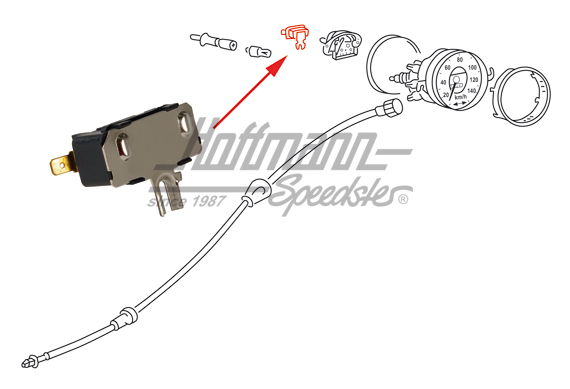
Many older Beetle models are equipped with a mechanical fuel gauge. This system uses a float inside the fuel tank, whose movement is transmitted to the gauge in the dashboard through a mechanical connection. This allows the fuel level to be displayed without electronic measurement.
Understanding the component group
Mechanical fuel gauges are particularly common in VW Beetle models produced between August 1961 and July 1967. Their simple design reflects the vehicle's original engineering concept, making them especially popular for authentic restorations.
For the gauge to function reliably, all components must work together correctly. In addition to the fuel gauge itself, the fuel sender and its connecting components play an important role. Worn or damaged parts can cause the displayed fuel level to differ from the actual amount of fuel in the tank.
Inspecting condition and differences
Throughout the production history of the VW Beetle, fuel level measurement technology continued to develop. While older models were often equipped with mechanical fuel gauges, later production years introduced electrical systems.
An electrical VW Beetle fuel gauge receives fuel level information through an electrical signal from the fuel sender unit. Both versions serve the same purpose but differ in their operating principles and the replacement parts they require.
Four checks before selecting a part
When replacing a fuel gauge, it is therefore important to consider the model year, the existing technology, and the compatibility of the individual components. A mechanical fuel gauge requires different connecting parts than an electrical version. Only when all components are compatible can the fuel level be measured and displayed correctly.
In addition to the fuel gauge itself, the fuel sender components are essential for a properly functioning system. They support the correct installation, connection, and operation of the individual parts. Especially in a vintage vehicle whose technology has been in use for decades, these components deserve particular attention.
- The fuel gauge consistently displays an incorrect fuel level.
- The needle no longer moves or remains stuck in one position.
- The displayed values fluctuate unusually strongly.
- The fuel gauge only works intermittently or stops functioning
Choosing suitable components
Exposure to fuel, temperature fluctuations, extended periods of storage, and natural ageing can cause components to deteriorate over time. Damaged connections or corrosion can also affect the performance of the fuel gauge.
Suitable fuel sender components help restore the reliability of the system while preserving the original technical design of the VW Beetle. During a restoration, it is therefore worth checking not only the fuel gauge itself but also the fuel sender and its additional components.
For related parts, see Electrics and Lighting.
Frequently asked questions: Fuel sender, add-on-parts
How do I identify the right Fuel sender, add-on-parts version for my Beetle?
Compare the exact vehicle variant and the existing component with the individual product information. Mounting position, connections and fixing points may differ.
Is the category name alone enough to select a part?
No. The category helps with navigation but does not confirm compatibility. Always check dimensions, specifications and fitment information.
What should I check before ordering?
Check the installation location, existing markings, fittings and any additional parts required, where these details are relevant to the component.
What if my classic car has been modified or repaired before?
Use the parts actually installed as your reference. Previous repairs or modifications may mean the original equipment details no longer match.
What can I do if I am unsure about the fit?
Prepare the vehicle details, photos and measurements or part numbers when available. Confirm compatibility before ordering and use qualified help for safety-critical work.