
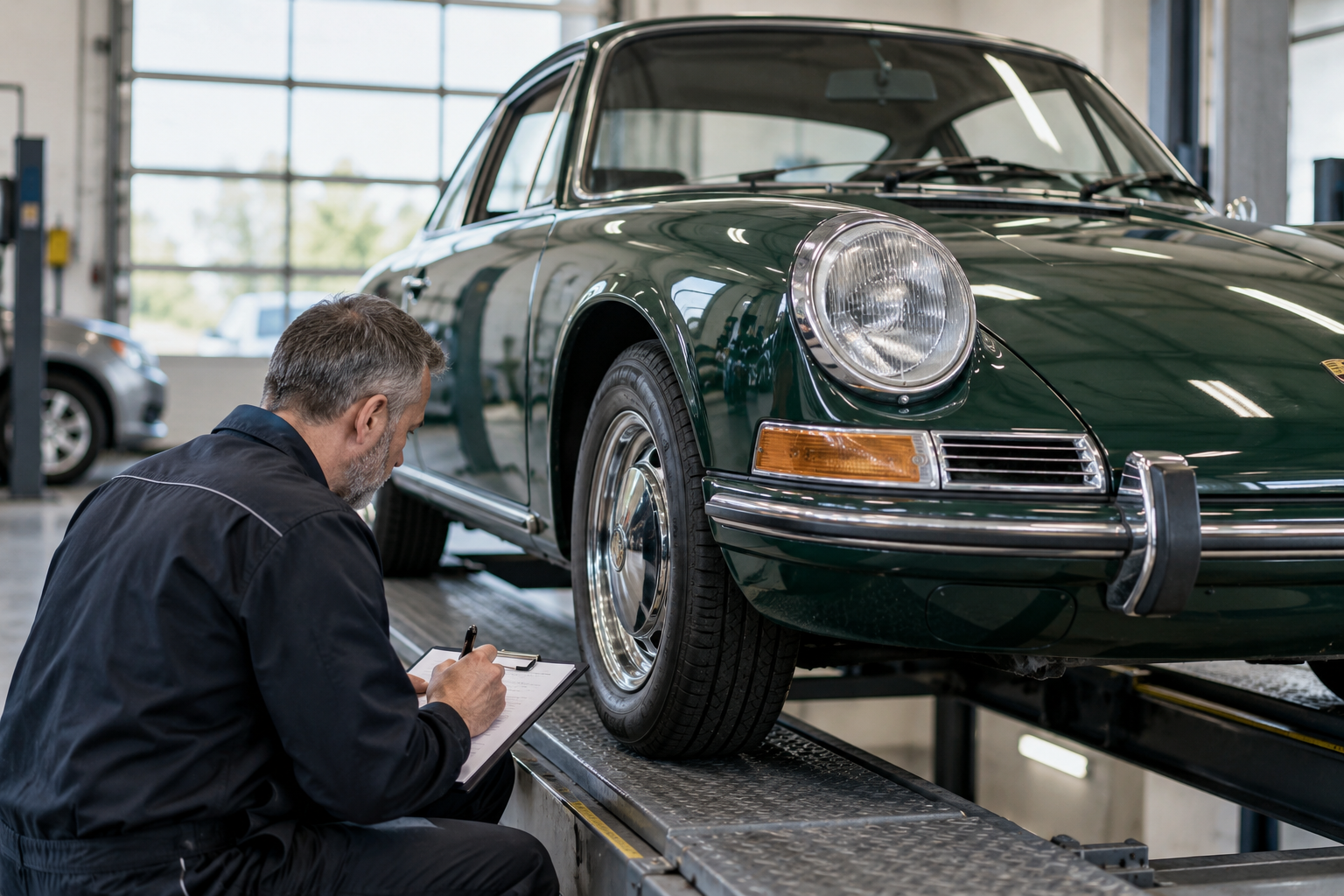
TÜV Inspection Report for Classic Cars – Your Path to an H License Plate
The Most Important Information at a Glance
- For a vehicle to be classified as a classic car and subsequently registered with an H license plate in Germany, an inspection report in accordance with Section 23 of the German Road Traffic Licensing Regulations (StVZO) is required.
- The vehicle must generally be at least 30 years old, largely correspond to its original condition and be in a good state of preservation.
- As part of the classic car assessment, an inspection equivalent to the general roadworthiness inspection in accordance with Section 29 StVZO is generally also carried out.
- Period-correct modifications do not automatically prevent a vehicle from receiving an H license plate. Among other factors, it is important whether the modifications are appropriate to the vehicle's era and legally permissible.
- The costs vary depending on the inspection organization, vehicle type and German federal state. Additional costs may arise for emissions testing, data sheets, modification approvals or necessary repairs.
TÜV Inspection Report for Classic Cars: Requirements, Procedure & Costs
Anyone presenting their classic vehicle for an official assessment should not wait until the day of the TÜV appointment to check whether all requirements have been met. Especially in the case of restored, imported or modified vehicles, it is advisable to consider the originality and legality of the installed components at an early stage. Technical safety, a good state of preservation and a traceable vehicle history provide a solid basis for a successful assessment in accordance with Section 23 StVZO.
What Is a TÜV Inspection Report for Classic Cars?
When people in Germany refer to a TÜV inspection report for classic cars, they usually mean the assessment in accordance with Section 23 of the German Road Traffic Licensing Regulations (StVZO). This assessment is required for a vehicle to be officially classified as a classic car and for the owner to subsequently apply for an H license plate.
The assessment is not based solely on the age of the vehicle. The expert also evaluates whether the vehicle is worth preserving and can be regarded as part of Germany's automotive cultural heritage.
The inspection report may be issued by appropriately authorized experts, inspectors or inspection engineers. In addition to TÜV, other recognized inspection organizations may therefore also carry out the corresponding assessment.
It is also important to distinguish between a classic car inspection report and a vehicle valuation report. While the assessment in accordance with Section 23 StVZO is used to classify a vehicle as a classic car, a valuation report primarily documents the condition and value of a vehicle, for example for insurance purposes or when buying or selling the vehicle.
What Are the Requirements for a Classic Car Inspection?
The best-known requirement is the 30-year rule. A vehicle can generally be classified as a classic car if it was first registered for road use at least 30 years ago. However, age alone is not sufficient. The following aspects are particularly important during the assessment:
- Good state of preservation: The classic vehicle should be well maintained and worth preserving. Normal signs of use and authentic patina are generally acceptable. However, serious technical defects, extensive corrosion, accident damage or improper repairs may prevent a positive assessment.
- Largely original condition: The vehicle's main components should correspond to the original specification. However, this does not mean that every component must still date back to the year of first registration. Professional repairs and replacement parts are, of course, normal for a vehicle that is several decades old.
- Period-correct modifications: Modifications do not automatically disqualify a vehicle. Changes may, for example, be accepted if they can be proven to have been carried out within the first ten years after initial registration or if they could have been carried out during that period. Certain other historically appropriate modifications may also be accepted. The specific design and the inspector's assessment are always decisive.
- Roadworthiness: The vehicle must also meet the applicable technical safety requirements. An authentic-looking classic vehicle will therefore not receive a positive inspection report if it has safety-related defects affecting components such as the brakes, steering or suspension.
Which Parts of a Classic Car Are Inspected?
During the assessment, the inspector evaluates the vehicle as a whole. In addition to roadworthiness, the main question is whether the condition and configuration of the vehicle are consistent with its history.
The inspection includes, among other things:
- Bodywork and chassis
- Engine and drivetrain
- Brake system
- Steering and suspension
- Wheels and tires
- Lighting and electrical system
- Windows and glazing
- Interior and equipment
- Paintwork and exterior appearance
- Existing modifications and alterations
Particular attention is paid to significant modifications. A different engine, modern wheels, modified suspension or a completely modernized interior may affect the vehicle's eligibility for classic car status.
Anyone restoring or customizing a classic VW Beetle, Volkswagen Bus, Porsche or another historic Volkswagen should therefore consider whether the chosen components are compatible with a future H registration before carrying out the work.
How Does the Classic Car Inspection Process Work?
Before the actual inspection, it is advisable to check the vehicle thoroughly. Especially after a long period of storage, even minor technical defects can result in the vehicle having to be presented for inspection again.
At the scheduled appointment, the vehicle is first identified. Among other things, the vehicle identification number and vehicle data are compared with the available documents.
The technical inspection then takes place. Under Section 23 StVZO, the classic car assessment generally also includes an inspection equivalent to the general roadworthiness inspection in accordance with Section 29 StVZO. The inspector therefore checks the vehicle's roadworthiness while also assessing the characteristics relevant to its classification as a classic car.
This is followed by an evaluation of originality and state of preservation. Modifications, replacement parts and restoration work are assessed with regard to their legality and historical appropriateness.
If all requirements are met, the vehicle owner receives a positive inspection report in accordance with Section 23 StVZO. This report can then be used to apply for an H license plate at the responsible vehicle registration authority.
Which Documents Should You Bring to the Inspection?
The better the vehicle's history is documented, the easier it is to verify its originality, particularly in the case of restored or modified vehicles.
It is advisable to bring the vehicle registration documents as well as records relating to restoration work and modifications. Historical brochures, owner's manuals, technical data sheets, old vehicle registration documents, invoices, photographs or proof of installed components can also be helpful.
Especially in the case of rare vehicles or models with extensive modifications, these documents can help the expert correctly assess the vehicle's historical condition. Additional technical documents or a vehicle data sheet may be required for imported vehicles.
How Much Does a TÜV Inspection Report for a Classic Car Cost?
There is no standardized nationwide fee. The cost depends on factors such as the inspection organization, region and vehicle category.
As a guideline, according to the TÜV NORD price list for North Rhine-Westphalia valid from January 1, 2026, the classic car inspection in accordance with Section 23 StVZO currently costs €150.00 including VAT for a passenger car or motor vehicle weighing up to 3.5 tonnes.
Different fees may apply in other regions. Additional costs may also arise, for example for a separately required emissions test, additional technical inspections or vehicle data.
If defects are identified during the assessment, repair and reinspection costs may also be incurred. Required modification approvals or individual vehicle assessments may further increase the total cost.
It is therefore advisable to ask the respective inspection organization about the current fees for the specific vehicle before the appointment.
What Happens If the Classic Car Does Not Pass the Inspection?
A negative result does not necessarily mean that obtaining an H license plate is no longer possible. The decisive factor is why the vehicle failed to meet the requirements.
In the case of technical defects, the affected components can be repaired and the vehicle can subsequently be presented for inspection again.
The situation can be more difficult if the vehicle has undergone fundamental modifications that are not considered period-correct or compatible with its historical appearance.
For this reason, anyone planning a restoration or modification should consider the future H registration from the outset. If components such as the engine, suspension, wheels, lighting or interior are to be modified, it is advisable to clarify in advance which solutions are compatible with classification as a classic vehicle.
Applying for an H License Plate After a Successful Inspection
A positive inspection report does not automatically mean that the H license plate can immediately be fitted to the vehicle. Instead, the report forms the basis for the subsequent application to the responsible vehicle registration authority.
If a positive inspection report in accordance with Section 23 StVZO is available and all other registration requirements have been met, the registration authority can issue the classic car license plate.
The H license plate can be identified by the letter “H” following the vehicle's regular registration number.
For many owners, the H license plate is not only a special distinction for their classic vehicle. Depending on the vehicle and how it is used, it may also provide tax or practical advantages.