
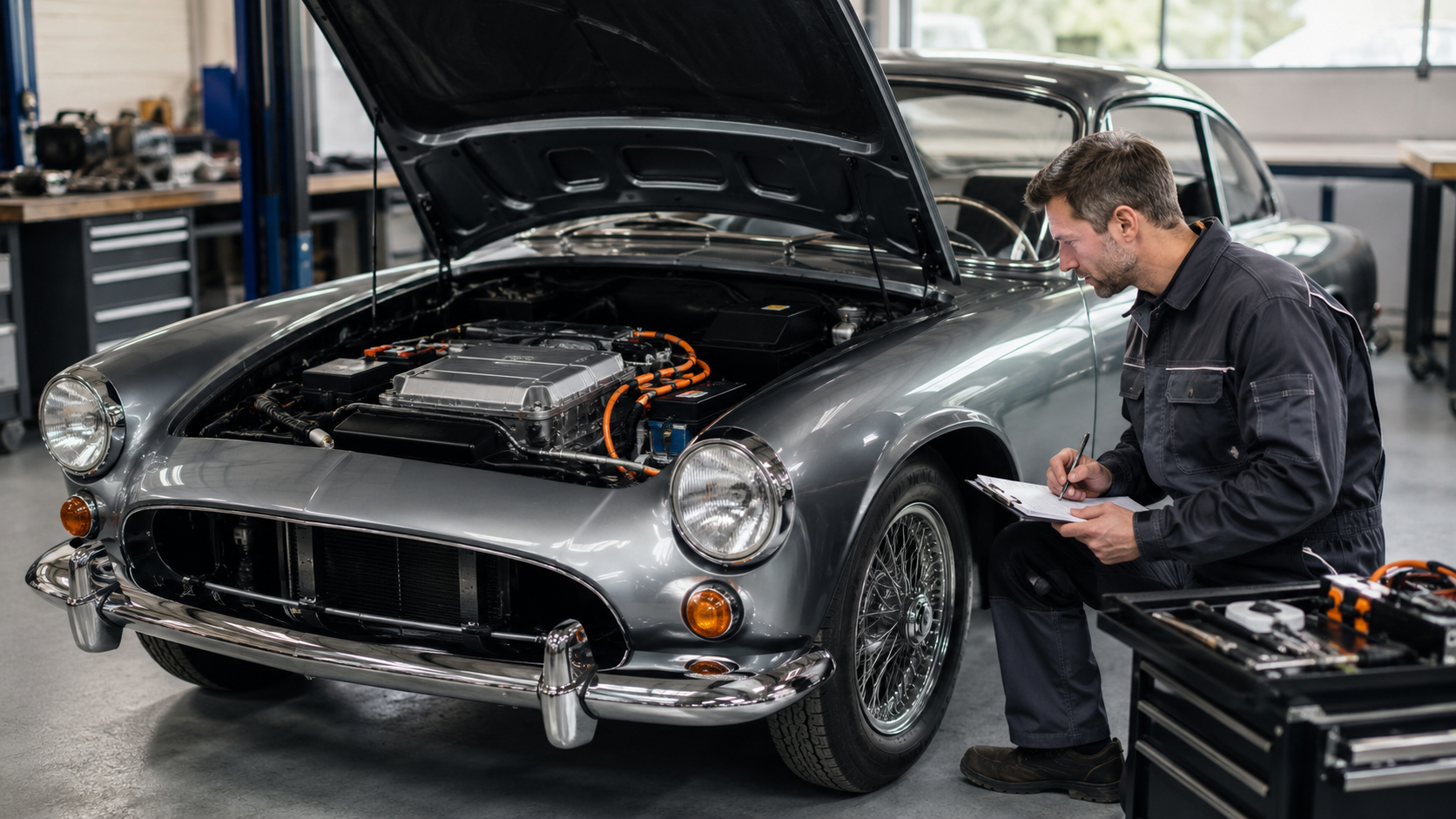
Classic Cars with EV Conversions: How Does an Electric Conversion Affect H-Plate Status?
Key Points at a Glance
- An H registration plate requires the vehicle to remain largely in its original condition or to feature period-correct modifications.
- The engine and drivetrain are among the most important major components of a classic vehicle.
- Replacing the internal combustion engine with a modern electric motor is generally not considered a period-correct modification.
- A modern EV conversion will therefore usually result in the loss of H-plate status.
- Road-legal approval and eligibility for H-plate status are two separate issues: an electrically converted classic car can be legally registered without an H plate.
- The conversion, battery, high-voltage system, axle loads and braking system should be discussed with an authorised inspection organisation before the project begins.
Classic Cars with EV Conversions: How Does an Electric Conversion Affect H-Plate Status?
A classic body combined with a modern electric drivetrain: for many enthusiasts of historic vehicles, this combination sounds particularly appealing. Converting a classic car to electric power can make it quieter, locally emission-free and potentially more suitable for everyday use.
At the same time, an EV conversion involves major changes to the vehicle’s historic technology. This raises a crucial question: will the vehicle retain its H registration plate after the conversion?
In most cases, the answer is no. A modern EV conversion will generally mean that the requirements for H-plate status are no longer met. Nevertheless, the converted vehicle may still be approved for use on public roads—normally without an H plate and only after an extensive technical inspection.
What Are the Requirements for an H Registration Plate?
A vehicle is not automatically recognised as a historic vehicle simply because it was first registered at least 30 years ago. To obtain an H registration plate, an expert assessment pursuant to Section 23 of the German Road Traffic Licensing Regulations (StVZO) is required.
The vehicle must also be in a good state of preservation, largely correspond to its original condition and serve to preserve automotive cultural heritage.
Originality is not assessed solely on the basis of the paintwork or interior. Particular attention is paid to the vehicle’s major components, including the engine and drivetrain.
Permitted modifications are primarily those that were made within the first ten years following the vehicle’s initial registration or that would have been technically possible and customary during that period. Non-period modifications may also be accepted if there is evidence that they were already carried out at least 30 years ago.
Why Does an EV Conversion Put H-Plate Status at Risk?
During an EV conversion, the original internal combustion engine is removed and replaced with an electric motor. Battery packs, power electronics, a battery management system, charging ports and high-voltage cables are also installed. In many cases, further modifications to the suspension, brakes or bodywork are required.
This completely changes one of the vehicle’s central historic components.
For a positive historic-vehicle assessment, the engine should generally be the original version or an engine from the corresponding vehicle model range. A modern electric motor with a lithium-ion battery will normally not meet this requirement in a classic vehicle that was originally manufactured with a petrol or diesel engine.
Important: Not every conversion that can obtain technical road approval is also compatible with H-plate requirements. The technical safety of the electric vehicle and its historic originality are assessed separately.
Are There Any Exceptions for Electric Classic-Car Conversions?
There is no general exemption for environmentally friendly drivetrains as part of the H-plate assessment.
Replacing a historic engine with a modern electric drivetrain is a considerably more extensive modification than, for example, retrofitting a catalytic converter.
Whether an exceptional historic vehicle can nevertheless receive a positive assessment is determined by the responsible technical expert on the basis of the individual case and the supporting documentation provided.
Can an Electrically Converted Classic Car Still Be Registered?
The loss of H-plate status does not mean that the classic car can no longer be driven on public roads following the EV conversion.
However, the conversion must undergo a technical inspection and be properly recorded in the vehicle registration documents. Since changing the type of drivetrain constitutes a substantial modification, an expert report for an individual operating permit will generally be required.
Section 21 StVZO provides for a technical description of the vehicle containing all information required for the new registration documents.
The inspection may take the following points into account:
- professional and secure installation of the battery,
- protection of the battery in the event of an accident,
- permitted gross vehicle weight and axle loads,
- braking performance and driving behaviour,
- power output and maximum speed,
- electrical safety and insulation,
- safe routing of high-voltage cables,
- protection against accidental contact and fire,
- electromagnetic compatibility,
- the charging port and charging electronics.
H Registration Plate or E Registration Plate?
Following a successful conversion, the vehicle may generally be classified as a fully electric vehicle.
Provided that all statutory requirements are met, an E registration plate may therefore be available instead of an H plate. A combination of H and E registration plates is not provided for under German law.
In practice, the owner must therefore decide which concept should take priority.
The tax treatment should be assessed individually before the conversion. The German Motor Vehicle Tax Act contains special provisions for vehicles that are subsequently converted to electric power, but these provisions are subject to specific technical and timing requirements.
What Happens to the Value of the Classic Car?
An EV conversion can have either a positive or a negative effect on the value of a classic car.
For buyers looking for a quiet, modernised classic vehicle, a high-quality conversion may be attractive. Traditional collectors, however, often regard the original engine as one of the vehicle’s most important value-defining features.
Irreversible modifications are particularly critical. If sections of the frame or body are removed, original mounting points are altered or historic components are discarded, reversing the conversion at a later date may be difficult or even impossible.
Anyone wishing to preserve the vehicle’s collector value as far as possible should therefore retain all removed components, avoid unnecessary alterations to the frame and bodywork, and document the entire conversion with photographs, invoices and technical records.
Conclusion
EV Conversions and H-Plate Status Are Rarely Compatible
An electric conversion combines the historic appearance of a classic car with modern mobility, but it also alters a fundamental part of the vehicle’s automotive heritage.
Because the engine and drivetrain are among the vehicle’s most important major components, a modern EV conversion in Germany will generally mean that the requirements for an H registration plate are no longer met.
The project may nevertheless be technically viable and capable of obtaining road approval. This requires careful planning, professional installation and a successful individual inspection.
Owners who retain the original engine and ensure that all modifications can be reversed at least preserve the possibility of restoring the vehicle to its historic condition at a later date.
Frequently Asked Questions About Classic-Car EV Conversions
Does Every Classic Car Lose Its H Plate After an EV Conversion?
A modern conversion using current electric components will normally no longer meet the originality requirements applicable to the engine and drivetrain.
Historically documented conversions that have already existed for a very long time may be assessed differently. The individual expert report is always decisive.
Can I Carry Out the EV Conversion Myself?
A self-built conversion is not prohibited in principle. However, technical evidence must be provided for all components and work, and the completed conversion must pass the required inspections.
Due to the high-voltage technology, battery installation and extensive approval requirements, working with a specialist conversion company is recommended.
Can I Reinstall the Internal Combustion Engine Later?
In principle, yes, provided that the original engine, transmission and all other components are still available and no irreversible modifications have been made.
A further technical inspection and a new assessment of the vehicle’s eligibility for H-plate status will then be required.
Does the Vehicle Remain a Classic Car After Losing Its H Plate?
In everyday language and because of its age, it remains a classic vehicle.
Legally, however, it does not have recognised historic-vehicle status for an H registration plate without a positive assessment pursuant to Section 23 StVZO.
Classic Cars with EV Conversions: How Does an Electric Conversion Affect H-Plate Status?
Absolutely. Since every vehicle, battery position and drivetrain concept is different, the inspection organisation should be involved during the planning stage.
This reduces the risk of expensive corrective work later on.